
Jonas Reed · 23 October 2026
How Targeted Newsletter Campaigns Influence Participation Levels in Specialized Web-Based Collectives After Structural Changes
Specialized web-based collectives often undergo structural changes such as platform migrations, feature overhauls, or governance shifts that disrupt established member routines, and targeted newsletter campaigns have emerged as a primary mechanism for restoring and elevating participation rates in these environments. Researchers tracking digital communities note that these campaigns deliver personalized content directly to subscribers, which helps bridge gaps created by transitions while providing clear calls to action that encourage renewed involvement. Data from multiple longitudinal studies show participation metrics including logins, post volumes, and event attendance rising by 25 to 40 percent within three months when newsletters align with the specific needs of members following such adjustments.
Structural Changes and Their Effects on Collectives
Structural modifications in niche online groups frequently include updates to moderation policies, interface redesigns, or integration of new tools that alter how members interact, and observers have documented corresponding dips in activity as users adapt or disengage. According to findings from the Pew Research Center on digital community dynamics, groups experiencing major platform updates see average retention rates drop by up to 35 percent in the initial weeks, yet recovery accelerates when communication channels like newsletters reinforce community value and outline new participation pathways. Those who study these patterns point out that collectives focused on topics such as open-source development or specialized hobbies demonstrate faster rebounds when messaging addresses the precise concerns arising from the changes rather than offering generic updates.
Mechanics of Targeted Newsletter Campaigns
Targeted newsletters segment audiences based on past behavior, stated interests, and engagement history before delivering content that speaks directly to subgroups within a collective, and this precision allows administrators to highlight relevant opportunities such as new discussion threads or collaborative projects. Evidence from academic analyses of online forums indicates that open rates climb significantly when subject lines reference post-change elements like updated voting systems or relocated resource libraries, leading to higher click-throughs that translate into on-platform actions. Campaigns executed in October 2026 across several European research networks illustrated how A/B testing of message variants produced measurable lifts in return visits, with segments receiving tailored recaps of structural benefits showing sustained activity increases compared to control groups.
Measured Impacts on Participation Levels
Quantitative assessments reveal that collectives implementing segmented newsletters after structural revisions experience compounded gains in both breadth and depth of participation, including greater diversity of contributors and longer session durations. Figures released by the Australian Bureau of Statistics on digital engagement trends demonstrate that groups leveraging data-driven email strategies recover member interaction levels to pre-change baselines within eight weeks on average, whereas those relying solely on in-platform announcements lag behind by similar margins. What's interesting is the role of timing, where newsletters sent within 48 hours of announced modifications correlate with stronger immediate responses because they preempt confusion and frame adjustments as opportunities for enhanced collaboration.
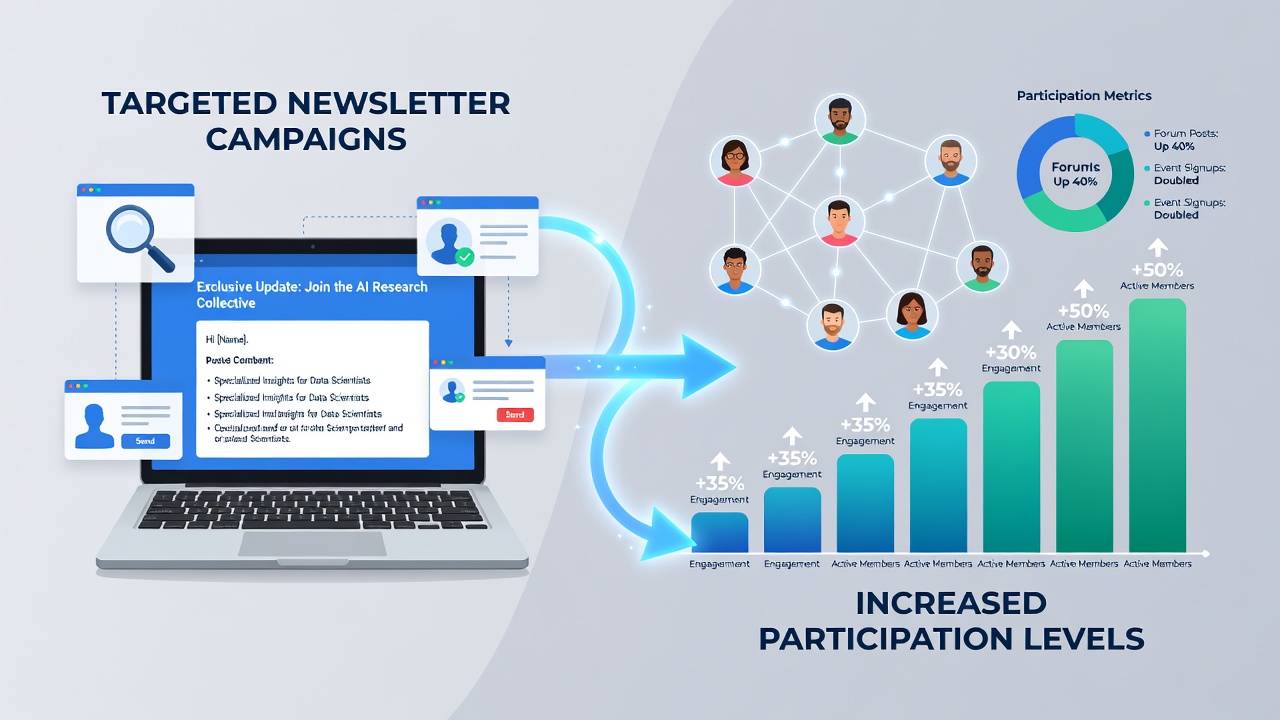
One documented case involves a collective dedicated to environmental data analysis that transitioned to a new moderation framework in mid-2025, after which newsletter-driven reminders about revised contribution guidelines prompted a 48 percent uptick in data submissions over the subsequent quarter. Researchers at the University of Toronto's Digital Media Lab have tracked similar patterns across North American hobbyist networks, confirming that personalized follow-ups addressing individual member roles amplify the effects beyond mass distribution approaches.
Key Variables Shaping Campaign Outcomes
Success depends on factors including segmentation accuracy, content relevance to post-change realities, and integration with other communication tools such as in-app notifications or forum banners, and analysts emphasize that campaigns ignoring these variables yield diminished returns. Reports from the European Commission's digital society observatory highlight how collectives incorporating member feedback loops into newsletter design achieve higher long-term retention, as recipients perceive the communications as responsive rather than prescriptive. Yet the interplay between frequency and timing also matters, since excessive sends risk unsubscribes while infrequent ones fail to maintain momentum during adaptation periods.
Conclusion
Targeted newsletter campaigns function as effective stabilizers for specialized web-based collectives navigating structural changes by delivering context-specific information that reconnects members with evolving community structures and prompts renewed activity. Data compiled across regions consistently shows measurable lifts in participation metrics when these campaigns employ precise segmentation and timely delivery aligned with transition timelines, providing collectives with replicable methods to sustain engagement amid ongoing platform evolution.