Jonas Reed · 25 September 2026
Mapping the Evolution of Referral Patterns Post-Domain Transition
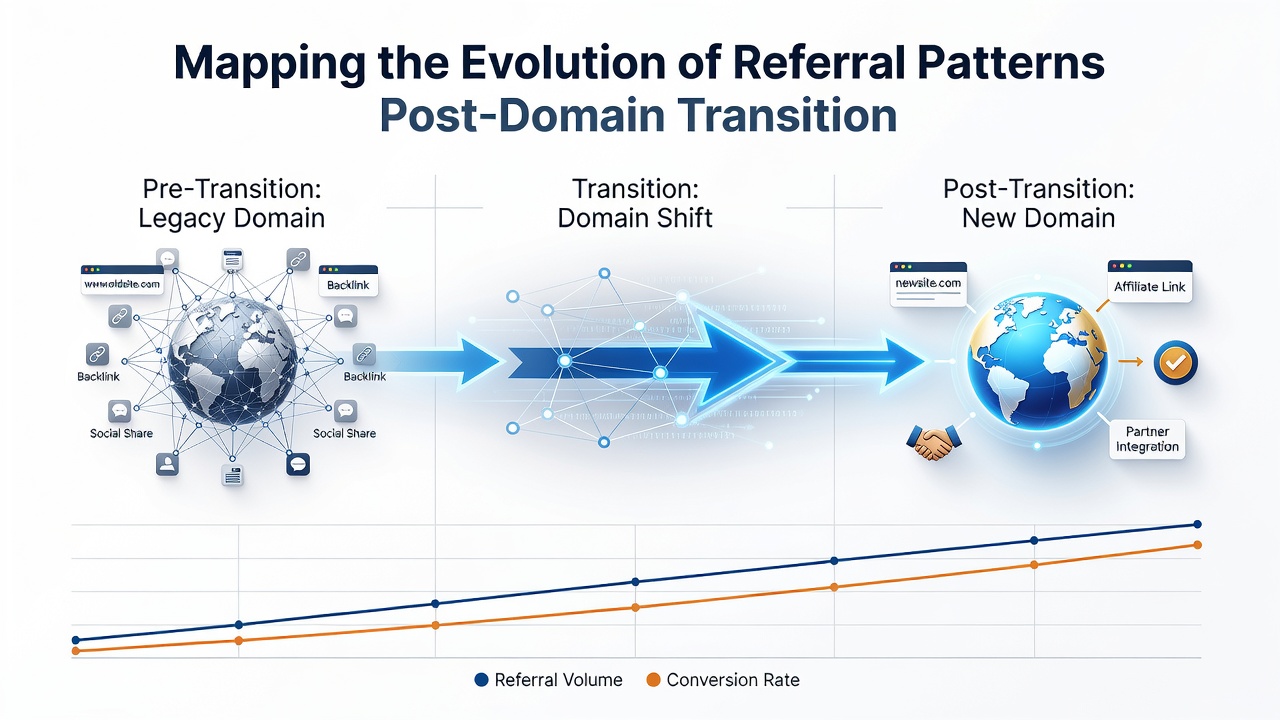
Domain transitions trigger measurable shifts in how referral traffic arrives at a site, and observers track these changes through analytics platforms that log incoming links and user pathways over extended periods. Researchers collect data on source domains, anchor text variations, and session durations to map the progression from initial disruption to stabilized patterns, while accounting for redirects that preserve some legacy signals during the move.
Initial Disruptions in Referral Sources
Right after a domain change takes effect, referral volumes from established sources often decline sharply because external sites continue pointing to the former address until their links receive updates. Data indicates that search engines and crawlers prioritize the new domain within days or weeks, yet manual updates on partner pages and directories lag behind, creating a gap that analytics tools capture as temporary drops in direct referrals. Those who monitor these metrics note that redirect implementations help retain a portion of the traffic, though the quality and context of the arriving sessions differ from pre-transition baselines.
Studies have documented how certain referral categories recover faster than others. Industry reports from organizations such as the International Association of Privacy Professionals highlight that professional networks and content syndication platforms adjust their outbound links more rapidly than smaller blogs or forum communities. This staggered recovery produces uneven patterns where high-authority referrals reappear first, followed by broader but lower-volume sources over subsequent months.
Tracking Changes Through Analytics Frameworks
Analytics setups rely on consistent tagging and server-side logging to follow referral evolution accurately. Teams configure events that distinguish between direct referrals, search-driven arrivals, and social media pathways, allowing precise measurement of how each category responds to the domain shift. Evidence from multiple migration projects shows that combining first-party cookies with server logs reduces attribution gaps that otherwise appear when third-party trackers encounter cross-domain issues.
What's interesting is the role of historical data comparison. Analysts align pre-transition and post-transition datasets to identify which referral domains maintain consistent contribution levels and which ones require new relationship-building efforts. Reports compiled by research groups at institutions like the Massachusetts Institute of Technology demonstrate that sites maintaining detailed logs achieve clearer visibility into these transitions, enabling targeted outreach to restore lost referral volume.
Long-Term Stabilization and New Pattern Emergence
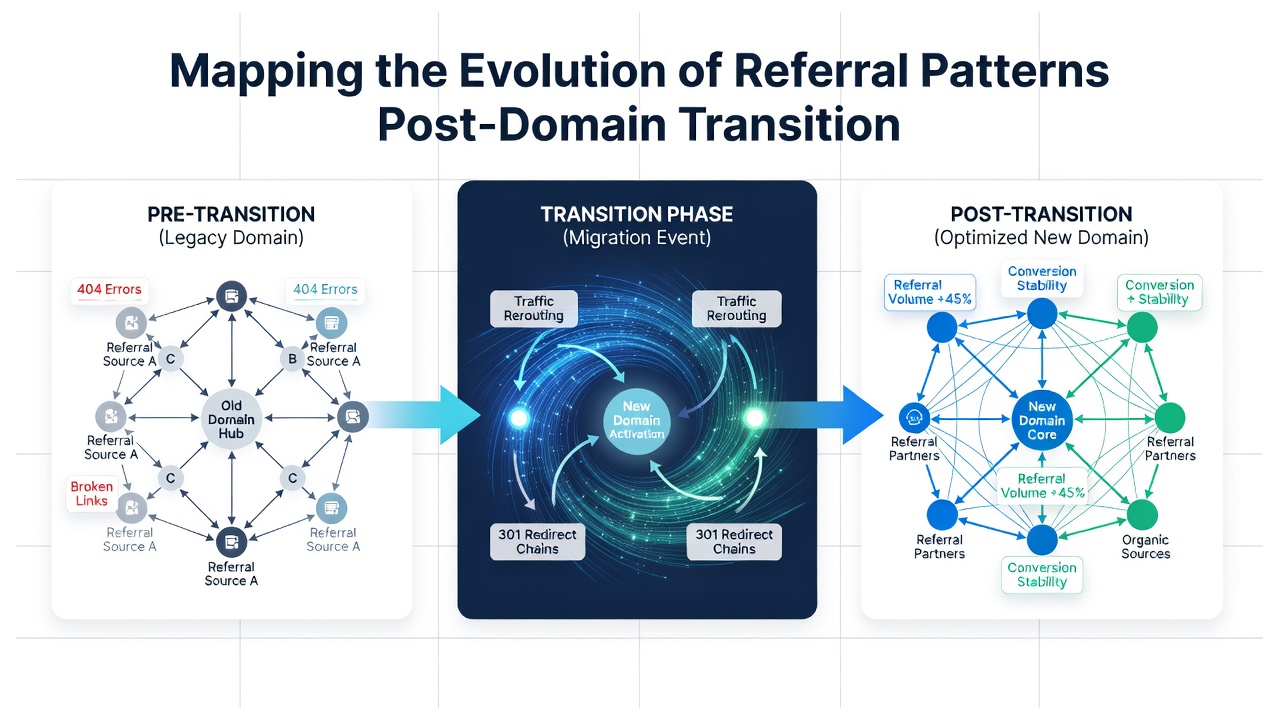
Over six to twelve months following a domain transition, referral patterns typically stabilize as external sites complete link updates and new backlinks accumulate around the current domain. Figures reveal that the proportion of referrals from previously dominant sources may decrease while contributions from emerging partners increase, reflecting broader changes in the site's content focus or audience reach. This evolution appears in aggregated data sets where referral diversity expands even as total volume returns to earlier levels.
But here's the thing: certain categories of referral traffic exhibit different recovery trajectories. Corporate and institutional sources often demonstrate steadier long-term patterns because their sites undergo slower editorial cycles, whereas news and blog referrals fluctuate more in response to content freshness and algorithmic updates. Observers note that September 2026 datasets from large-scale web crawls illustrated these distinctions across hundreds of documented domain moves, providing benchmarks for expected timelines in similar projects.
Geographic and Sector Variations
Referral evolution also varies by region and industry sector. Sites operating across multiple countries encounter additional complexity when local directories and regional platforms update links at different rates. Data compiled by Australian government digital economy agencies shows that sectors such as education and healthcare experience more gradual referral recovery due to regulatory review processes that delay link modifications on official pages.
Meanwhile, technology and media sectors tend to see quicker adaptation because their partner networks prioritize rapid link corrections. Cross-referencing these patterns with records from Canadian statistical agencies confirms that sector-specific timelines influence overall referral mapping strategies, prompting organizations to prioritize outreach based on source importance rather than uniform schedules.
Conclusion
Mapping referral pattern evolution after domain transitions requires sustained data collection and careful segmentation of traffic sources. The process reveals consistent phases of initial disruption, gradual recovery, and eventual stabilization that organizations can anticipate through established analytics practices. Continued documentation of these shifts supports more accurate forecasting for future migrations across diverse sectors and regions.