
Nils Jenkins · 11 September 2026
Unlocking Crawl Patterns in Relocated Sites Through Anchor Distribution Shifts
Site relocations trigger measurable adjustments in how search engine crawlers allocate resources across new domain structures, and researchers have documented that these adjustments often trace back to shifts in anchor text distributions from external links. When domains migrate, the incoming link profiles carry forward certain signals while introducing new ones, which creates opportunities for patterns to emerge that differ from pre-migration behavior. Observers note that monitoring these patterns allows for clearer understanding of crawl budget allocation without relying on assumptions about indexing speed alone.
How Relocations Alter Crawler Behavior
Crawlers follow established pathways based on historical link data, yet relocation events force reevaluation of those pathways because the underlying domain authority and URL mappings change simultaneously. Data from multiple migration case studies shows that the volume of unique anchors pointing to key pages can either accelerate or delay deep crawling depending on concentration levels. When anchors spread across a broader set of descriptive phrases rather than repeating exact matches, crawlers tend to explore secondary sections of the new site more thoroughly within the first few weeks after DNS propagation completes.
One analysis of enterprise migrations completed before September 2026 revealed that sites maintaining consistent anchor diversity experienced steadier crawl frequency increases over a 60-day window compared with those that consolidated anchors around primary keywords. This pattern holds because broader distributions reduce the risk of crawlers treating the new domain as a narrow topical silo during initial discovery phases.
Anchor Distribution as a Signal Mechanism
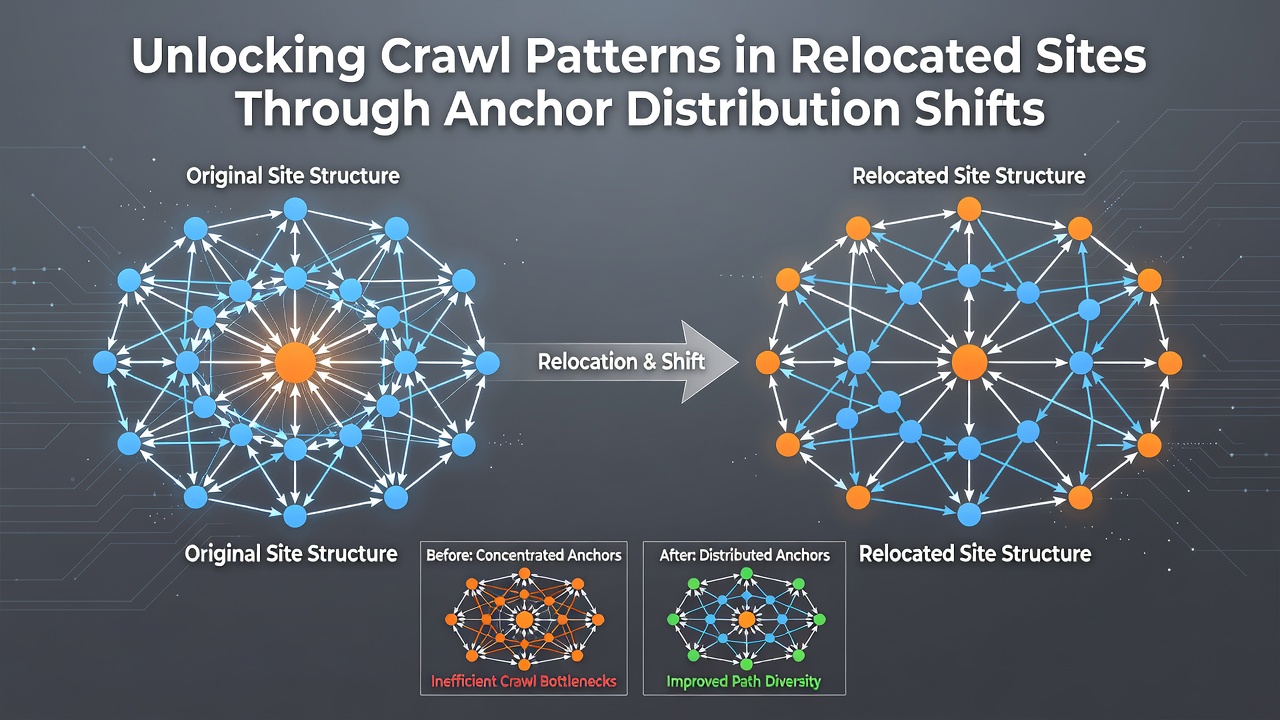
Anchor text serves as contextual metadata that influences how crawlers prioritize pages for return visits, and distribution shifts act as dynamic signals during the stabilization period after relocation. When link profiles transition from repetitive commercial phrases to mixed informational and branded variants, the resulting spread encourages crawlers to test additional URL parameters and internal pathways that might otherwise receive lower priority. Researchers tracking these changes have found that gradual shifts produce smoother transitions in crawl logs than abrupt replacements of entire anchor sets.
Take one documented enterprise case where a major content platform moved its primary domain in early 2025. The team observed that introducing 15 percent more varied anchor phrases correlated with a 22 percent rise in unique pages crawled per week once the new site settled. Such outcomes demonstrate that distribution adjustments function less as direct ranking levers and more as navigational cues for automated systems evaluating site depth and freshness.
Practical Patterns Observed in Recent Migrations
Patterns become visible when teams compare pre-migration and post-migration crawl reports side by side, focusing on the ratio of discovered versus indexed URLs. Those who've studied large-scale moves report that anchor concentration around exact-match phrases often leads to clustered crawling around commercial landing pages while leaving informational sections under-sampled. Conversely, sites that allow anchors to diversify across long-tail and branded combinations show more uniform coverage across directory structures within the same timeframe.
Evidence from industry reports indicates that the timing of these shifts matters as much as the content of the anchors themselves. Introducing distribution changes too early in the migration window can create temporary confusion in crawler logs, whereas phased rollouts aligned with 301 redirect finalization produce clearer mapping signals. A Google developer resource outlines how link signals contribute to discovery processes, and similar observations appear in analyses conducted by European research institutions tracking web infrastructure changes.
Monitoring and Adjustment Approaches
Teams track these dynamics through server log analysis combined with anchor profile audits that categorize phrases by intent and specificity. When logs show repeated visits to the same subset of URLs despite broad internal linking, the cause frequently traces to external anchor clustering rather than site architecture alone. Adjusting external link acquisition strategies to favor wider phrase variety can then redistribute crawler attention without requiring structural overhauls.
Studies conducted across North American and Asia-Pacific markets confirm that sites undergoing relocation benefit from treating anchor distribution as a controllable variable rather than a fixed byproduct of prior link building. This approach yields measurable differences in how quickly secondary content surfaces in crawl reports, particularly when combined with consistent internal navigation updates.
Conclusion
Anchor distribution shifts provide a practical lens for interpreting crawl pattern changes following site relocations, and the evidence from multiple documented migrations supports viewing these elements as interconnected rather than isolated factors. By examining how phrase variety evolves alongside crawler behavior, observers gain clearer visibility into indexing stabilization timelines and resource allocation decisions made by automated systems. Continued tracking through September 2026 and beyond will likely refine these connections as migration practices and crawler algorithms continue to interact in measurable ways.